


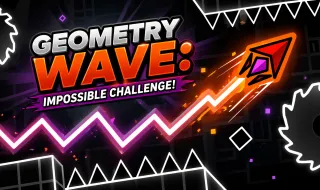
Geometry Wave: Impossible Challenge!
Dive into Geometry Wave: Impossible Challenge!, master precise controls, dodge deadly obstacles, and push your reflexes to conquer every intense level.
Overview
Geometry Wave: Impossible Challenge! is a fast-paced arcade game built around one deceptively simple idea: control a constantly moving wave and survive. You guide a small, arrow-like waveform through tight corridors, spikes, and shifting obstacles that leave no room for hesitation.
Core Gameplay
The game revolves around control and anticipation. Your wave moves diagonally in a zigzag pattern, and your task is to manage its direction to avoid crashing.
Your mission is straightforward:
- Reach the end of each level
- Avoid all obstacles
- Maintain control as difficulty increases
Despite its simplicity, the challenge quickly intensifies. Obstacles appear in tight, unforgiving patterns, requiring quick reactions and precise timing. A single mistake—even for a split second—will send you back to the start.
Levels & Difficulty
The game features seven levels, each increasing in difficulty.
- Early levels introduce basic mechanics with wider spaces and slower pacing
- Mid-level stages tighten the gaps and introduce more complex patterns
- Final levels demand near-perfect timing and sharp reflexes
A clever visual system reflects difficulty through character expressions—from calm smiles to intense, angry faces—hinting at the challenge ahead.
Controls
- Hold: Move the wave upward
- Release: Move the wave downward
Why It Feels So Addictive
- Levels are short, making restarts quick and seamless
- Each attempt helps you learn and improve
- Progress feels tangible as your skills develop over time
Tips to Improve Faster
- Focus on rhythm, not panic: Treat each level as a pattern rather than chaos. Once you find the rhythm, movement becomes more natural.
- Think ahead: Don’t just react—anticipate upcoming obstacles to stay in control.
- Use small, precise inputs: Overcorrecting leads to mistakes. Subtle movements are more effective than long holds.
- Embrace failure: Crashing is part of the process. Improvement comes through repetition and muscle memory.
More Skill Games